Guardian ‘international development journalism’ contest excludes journalists from developing nations — again

[I am reposting this piece from 12 March 2012 today, as once again the contest is for UK writers only.  Once again it invites writers who ‘have never been to the developing world‘ to submit articles rather than inviting journalists who know their stories intimitately. ]

Once again The Guardian has announced a journalism competition that has international development as its theme, but which excludes journalists in developing countries from entering. Continue reading

If we cook these tiny wasps, we put the heat on hundreds of other species

Poll2

From the wings of tiny creatures hang the fates of hundreds of bird and mammal species, and perhaps even entire rainforests. They are fig wasps and they play a disproportionate role in the grand drama of life on Earth. They shape our own story too because of this. But new research warns that these insects could be “extremely vulnerable” to global warming.

This matters because each of the 750+ species of fig tree (Ficus species) relies utterly on particular species of fig wasp to pollinate its flowers. Without the fig wasps there would be no fig seeds to create the next generation of trees, and there would be no ripe figs for animals to eat.

In the case of any other group of trees this would not be such a big deal, but figs are special. Their pollinator wasps only live for about a day and each wasp species can only lay its eggs inside the flowers of its specific fig partner. So, to keep their pollinator species alive, each fig species needs to produce flowers and figs year-round. This means a year-round supply of food for birds and mammals, and helps to explain why figs feed more creatures than any other trees do (see A job for conservation’s keystone cops).

In the late 1990s, I set out to find out just how many animal species eat figs. The answer is an astounding 1,200-plus species, including ten per cent of all birds and six per cent of all mammals – see Who eats figs? Everybody). That’s the variety of life that stands to suffer in some way if fig-wasps disappear. Now, in a new study in the journal Biology Letters, Nanthinee Jevanandam of the National University of Singapore and colleagues provide a chilling insight into what a warmer world could mean for these wasps.

In a laboratory, they exposed the pollinators of four Ficus species to temperatures between 25°C and 38°C and to a various levels of humidity. The lifespan of all four species fell steadily as the temperature rose. By 36°C, the lifespan of three of the species had fallen to just two hours. In the wild this would give the wasps hardly any time to find a fig of the right species in which to pollinate and lay its eggs. It would hurt both wasp and fig species. This is the Achilles heel of a partnership that has existed for 80 million years. It is here that we might expect to see the relationship break down, with consequences for other species.

This has happened before. In the 1990s, fig-wasps in northern Borneo went locally extinct after a severe drought, and in Florida they disappeared when a hurricane wiped them out. In both cases, fig-wasp populations eventually bounced back — thanks to the fact they can disperse for tens of kilometres in the day or two they live. But a sustained temperature increase — like that which climate scientists predict will be a reality worldwide by the end of the century — is a different matter. As we turn up the global temperature we change the chemistry of life.

I asked Nanthinee whether she thought fig-wasps could adapt to a rise in temperature, either in their physiology or their behaviour — by flying at a cooler time of day for instance. “Fig wasps can produce up to 12 generations in a year in the aseasonal tropics, and so acclimation or genetic adaption is a possibility,” she said. “But more research has to be carried out to ascertain this. As to the possibility flying at different times, it is difficult to predict.”

The wasp species she and her colleagues studied came from distinct branches of the fig-wasp family tree, so they think their results will be relevant to hundreds of other fig-wasp species, the trees they pollinate and the animals that eat their figs. But these little wasps might have surprises in store for us yet. After all, they survived the mass extinction that saw off the dinosaurs, 65 million years ago. They might outlive us too.

Their story is a reminder that we are just new here, and that between our kisses, our fights and our smiles, we tend to stumble about breaking things before we know how they work.

Photo credit:
Valisia malayana fig-wasps at a fig of their host tree Ficus grossularioides (Nanthinee Jevanandam)

Related posts:
The humbling history of the tiny wasps that upset a Jurassic Park narrative.

Reference:
Jevanandam, N., Goh, A.G.R. & Corlett, R. 2013. Climate warming and the potential extinction of fig wasps, the obligate pollinators of figs. Biology Letters 9: X-X.  Published online March 20, 2013 doi: 10.1098/rsbl.2013.0041

A bit naughty? Secret filming exposes murky world of rainforest politics

Global Witness has released footage that exposes the way elites have carved up and sold off the tropical forests of Sarawak in Malaysian Borneo, then siphoned away millions of dollars through illegal tax dodges. Global Witness filmed the footage in secret when one of its team posed as an investor who wanted to buy up land in Sarawak so he could set up oil palm plantations.

The main targets of the investigation are Tan Sri Abdul Taib Mahmud — who has been Sarawak’s Chief Minister for over 30 years and controls access to forests there — and members of his extended family.

“This film proves for the first time what has long been suspected — that the small elite around Chief Minister Taib are systematically abusing the region’s people and natural resources to line their own pockets,” said Tom Picken, Forest Team Leader at Global Witness, in a press release. “It shows exactly how they do it and it shows the utter contempt they hold for Malaysia’s laws, people and environment.”

In Sarawak, the website FZ.com caught up with the Chief Minister today and reported his response to the claims:

“Ok I saw the so called proof. Could it not be someone who tried to promote themselves to be an agent to get favours from me?  It has nothing to do with me. I think it is a bit naughty of them.”

Taib is a master of public relations — as revealed in open letter that The Sarawak Report sent to British reality TV star Ben Fogle after he gushed good publicity about his recent trip to Sarawak. While it is clear that something “naughty” has indeed happened to Sarawak’s forests, Taib seems unconcerned by the latest salvo in an ongoing campaign against him.

Here’s the Global Witness video… The FZ.com interview follows:

Kill off the animals and you change the forest — fast

Last year I brought you the story of Lambir Hills National Park, a Bornean forest in which I used to live and work, where hunting and other pressures have forced into extinction much of the biggest wildlife species (see The near empty forest that proves conservation is failing).

It describes how recent surveys had failed to find 20 percent of the park’s resident bird species and 22 percent of its mammal species. The forest is emptying fast. The losses include half of the park’s primate species and six out of seven hornbill species —  all important dispersers of rainforest seeds. Sun bears and gibbons, bearded pigs and flying foxes all once called Lambir Hills home. Today it is hard to find an animal that weighs more than a kilogram in the national park.

Now researchers have shown what these extinctions mean for the forest itself. Rhett Harrison and colleagues tracked the fates of over 470,000 trees of more than 1,100 species for a 15-year period since intense hunting began there.

In a new study published in Ecology Letters, they have shown that the forest has changed markedly. There are far more trees now — the density of saplings increased by over 25 per cent between 1992 and 2008 — probably because there are fewer deer and other mammals to eat the young plants. But overall the diversity of trees has fallen. And compared to species that rely on gravity or wind to spread their seeds, there has been a relative decline in the number of new trees from species that depend on animals to disperse their seeds.

Species with animal-dispersed seeds — especially those with bigger seeds — are also more clustered than they were before hunting took off. This is probably because the loss of large fruit-eating animals means that seeds, on average, now travel shorter distances. There was no increase in clustering among species that need no animal assistance to spread their seeds.

The authors write: “Fruit that would formerly have been eaten by hornbills, gibbons or fruit pigeons, all of which are efficient long-distance seed dispersers, are now unlikely to be fed on by anything larger than a bulbul or a barbet”. For those of you who don’t know the birds of Borneo, members of the latter two types are both small enough to fit in a trouser pocket.

The researchers could draw their conclusions because Lambir is home to one of the world’s longest running forest studies. In 1992, scientists marked out a 52 hectare patch of the forest and then tagged, measured, mapped and identified every tree bigger than 1 cm diameter at breast height. In 1997, 2003 and 2008 they went back and repeated the exercise, each time taking several months to complete the task.

Their massive datasets, which track the identity and positions of around half a million trees every 5-6 years can animate the forest’s history. Like the photographs that form time-lapse videos, these periodic census snapshots reveal the patterns of life over time.  The next census of the 52-hectare plot, which is due to take place soon, will add a critical fifth image that further refines the picture of a forest in flux.

The results are already striking but, as the authors note: “the full impacts of defaunation at Lambir are only likely to be realised over several plant generations.” So far, none of the species that depends on big animals to disperse its seeds has gone extinct. That’s just a matter of time.

Reference:

Harrison, R. D. et al. 2013. Consequences of defaunation for a tropical tree community. Ecology Letters. Article first published online: 12 MAR 2013 DOI: 10.1111/ele.12102

In under three minutes, a year in a forest

Samuel Orr has been good enough to publish online this time-lapse video he shot from a house in a nature reserve near Bloomington, Indiana. He stitched it together from 40,000 images he took over a 15-month period. It’s a wild and beautiful place. On his website, Orr says: “I’d often look out the window and see turkeys, deer, flying squirrels, vultures, possums, huge orb weaving spiders, and a dizzying array of songbirds and woodpeckers.”

The result is a stunning portrait of the seasonal cycles that breathe life through every layer of the forest — and the soundscape is a rich as the view. Here Orr describes creatures we can hear.

“I tried to put in wildlife songs and calls appropriate to the season.  For instance, the honking during what is late winter are Sandhill Cranes, which used a migratory flyway that passed directly overhead.  Many of the calls were recorded on sight, others were from elsewhere in Indiana.  Animals heard include migratory songbirds, spring peepers, tree frogs, cicadas (periodical and annual), turkeys, coyotes, elk, and wolves.  While there are no wild wolves or elk native to Indiana anymore, but for hunting long ago they would still roam the surrounding hills.  Maybe they’ll be back some day.”

You can read more about his work at Motionkicker.com

Time to join the dots on environmental murders

In recent days the blood of environmentalists has flowed once again. A man in China got beaten. A man in Thailand was shot dead. Both had campaigned against illegal pollution. They are just the latest in a long — and fast-growing — list of people whose exposure of environmental crimes has made powerful men their enemies. [*see six updates below]

On Monday a gunman shot Prajob Naowa-opas four times in broad daylight in Chachoengsao province, Thailand. The Bangkok Post reported that local police thought the murderer was a professional hit and that “Prajob’s public exposure of and active opposition to toxic waste dump sites was the probable cause”.

Around 2,500 kilometres away in China’s Zhejiang Province, lives a kindred spirit called Chen Yuqian, a 60-year-old resident of Pailian village. For ten years he has campaigned against paper mills he says are polluting the nearby river with toxic waste.

Last week he and other activists used online social media to challenge environmental officials to bathe in the river they were charged with keeping clean. But according to media reports this prompted a gang of men to raid his home at 6am on Sunday and beat him with their fists.

Two cases of violence against campaigners within a week might seem a coincidence but these are dangerous days for activists and journalists who speak out against powerful people whose actions harm the environment.  In many parts of the world organised crime cartels, corrupt government officials and military units with muscle to flex are the powers that decide how and when to silence those who expose their greed.

Sombath Somphone, the best known environmental and development campaigner in Laos, is still missing. On 15 December 2012, men abducted him and drove him away in a van when police stopped him on a street in Vientiane. Next door in Cambodia, a military policeman shot dead Chut Wutty, a prominent campaigner against illegal deforestation in April of that year. Five months later, journalist Hang Serei Oudom was axed to death there after reporting on links between the military and illegal logging (see Journalists are dying to tell stories of environmental plunder and They kill environment journalists, don’t they?).

Intimidation, violence and murder have long been the tools that the powerful have used to cow those who oppose their lust for timber, oil, gems, fast money and even the ‘pink gold’ of farmed shrimp. But according to UK-based environmental investigators Global Witness, the death rate is rising. Their 2012 report A Hidden Crisis [PDF] described more than 700 murders over the past decade — that’s more than one each week on average. By 2011, there were 106 deaths — more than two a week.

Last year gunmen slayed five rangers in Chad whose job it was to protect the last of the region’s elephants. In 2011, in Brazil, hired killers murdered three environmental activists in a single week. And in the Philippines, since 2010, assassins have killed twenty of the forest rangers who try in vain to stop illegal logging. Professor William Kovarik of Radford University lists many more murders here.

Are the numbers rising just because of better communications? Or is there a real upsurge — and, if so, is it a sign of things to come? Either way, one thing is clear. To too many powerful and greedy men, the life of an environmentalist — or a journalist or a park ranger — is worth a lot less than some logs or some oil, a handful of diamonds or an elephant’s tusks. And between courage and cowardice we all stand or fall.

[Update: 5 March 2013. The BBC reports that Venezuelan authorities are investigating the killing of indigenous leader, Sabino Romero, a well-known campaigner for the return of ancestral land to the Yukpa tribe. Mr Romero was shot dead on Sunday when two gunmen on a motorcycle opened fire on his vehicle on a motorway. He had earlier asked for police protection.]

[Update: 14 March 2013. Perween Rahman was murdered by masked gunmen on 13 March 2013 in Karachi, Pakistan. She worked with poor communities to help them gain legal title to land in the city’s informal settlements. The BBC reports that this may have made her enemies among local criminal groups intent on seizing land.]

[Update: 15 March 2013. On 12 March assassins murdered a Guatemalan activist and indigenous leader, Gerónimo Sol Ajcot, who was a senior member of the National Indigenous and Campesino Coordinating Council.]

[Update: 28 March 2013. Mongabay.com reports that on 22 March four masked men killed Onesimo Rodriguez, a Ngäbe indigenous Panamanian who opposed the Barro Blanco hydroelectric dam project.]

[Update: 28 March 2013. MiningWatch Canada reports that on 17 March the President of the Xinca Indigenous Parliament and three other Xinca leaders were abducted by a group of heavily armed masked men while on their way home from observing a public referendum on Tahoe Resources‘ Escobal mine in Guatemala.  Three of the men survived. Their vehicle was found with multiple bullet holes and one of the men — Exaltación Rámirez López — was found dead]

[Update: 9 April 2013. The Guardian reports that Russian journalist Mikhail Beketov —  a Russian journalist who suffered brain damage and lost a leg after a brutal assault that followed his campaign about forest destruction for a road-building project — has died after choking to death in hospital, aged 55.]

Related posts: They kill environment journalists, don’t they?

Mali’s giant trees and fortune-telling foxes

In 2010, I walked in parts of Mali where now the threat of violence dogs people’s daily lives. I loved every place I visited, but it was the mystique, peace and beauty of the portion known as Dogon Country that touched me most. It is a remote region near the middle of Mali, which itself lies landlocked at the heart of the hump we call West Africa.

Dogon

A sandstone cliff — 200 kilometres long and up to 500 metres high — divides the Dogon territory in two. Some of the Dogon people live atop it in the Bandiagara Highlands while others live on the Séno-Gondo Plain down below, or in villages that huddle in a line at the base of the cliff itself. My walk between these distinct worlds started in Sangha, a highland commune of mud buildings and massive baobab trees like this one. Even strong men look weak in their company.

4611998041_7e21c206b5_z

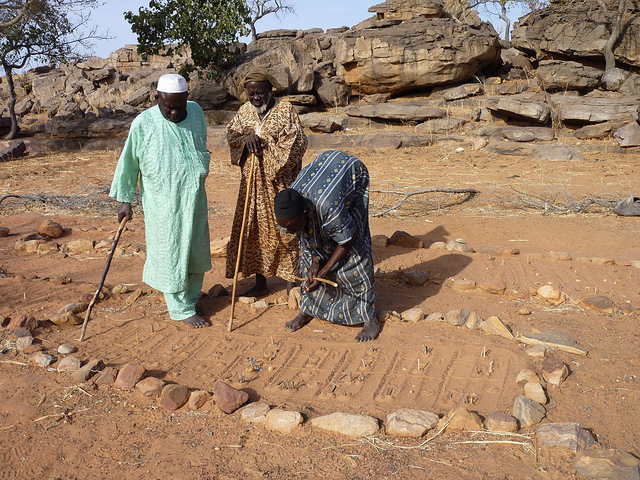
In the wilderness beyond Sangha stood a trio of elders who provide people with advice about problems or changes in their lives. To do this they seek the help of a sacred desert creature — the pale fox (Vulpes pallida). First the men use a stick to scribble symbols in the sand to represent a client’s questions and possible answers. Then they scatter peanuts over the marks they have left and go home for the night. After the sun sets, there is a good chance that a fox will come to eat the nuts. The next morning, the elders check which answers the fox has left its footprints on — and that is the advice they give.

4612000543_0f9b2a02a8_z

In the village after Sangha — a small place called Bongo — the air was ripe with the sweet scent of onions that grew in green fields all around. They became a cash crop in the Dogon Country in the 1930s when French colonists created a demand for them. When the onions are full grown their farmers pound them into a paste, which they then roll into balls to dry in the sun. In the past these fragrant spheres served as currency. Today they sell in distant markets and are a vital source of income in this poor corner of a poor country.

4611999195_4df80c9942_z

After Bongo — where children had filled the air with songs — the landscape became a place of peace. The silence was stunning. Even birds seemed shy. Yet more than 120 species of them live here. The plateau is also home to over 300 plant species, many of which are hard to find these days in less remote parts of Mali.

4612616958_19e75454df_z

To reach the Dogon villages on the plain, I clambered over rocks along an ancient path that hugged the face of the cliff. That’s Burkina Faso in the distance across the plain.

4612036391_37216a9549_z

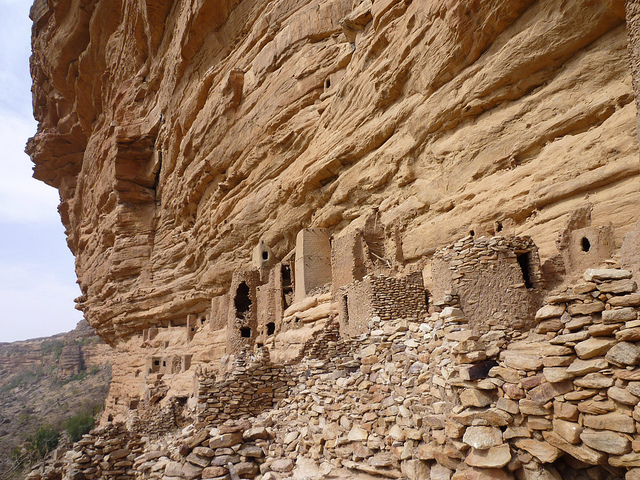
The Dogon people migrated to this area in the 1400s from their homeland far to the South-West. When they arrived they found another group of people called the Tellem living in caves on the cliff. Little is known about these “little red people” and it is not clear whether the Dogon killed them, chased them off or assimilated them into their own society. According to Dogon oral history, the Tellem people could fly, and that’s how they built structures like these high in the cliff face to store grain and house their dead ancestors.

4612004415_3d600367f9_z

The picture below shows a Dogon village that sits at the base of the cliff, beneath the older Tellem structures on the cliff face. The Dogon people migrated to this place because they didn’t want to convert to Islam. When France colonised Mali, the Dogon people again hid and resisted change (apart from adopting onions, that is). Their animist culture survives in part thanks to the remote landscape they chose to call home.

4612617972_b4b6989e8b_z

Three years ago when I walked in Mali I felt only safety. Today it is a place where danger lurks. Cowards with guns threaten good people for making music, sending girls to school or simply believing in another god. The old men and the pale foxes may not have foretold this but the Dogon have seen it all before.

4612651336_1478dd89b5_z

Who eats figs? Everybody

“The proper way to eat a fig, in society,” wrote DH Lawrence, “is to split it in four, holding it by the stump, and open it, so that it is a glittering, rosy, moist, honied, heavy-petalled four-petalled flower. … But the vulgar way, is just to put your mouth to the crack, and take out the flesh in one bite.”

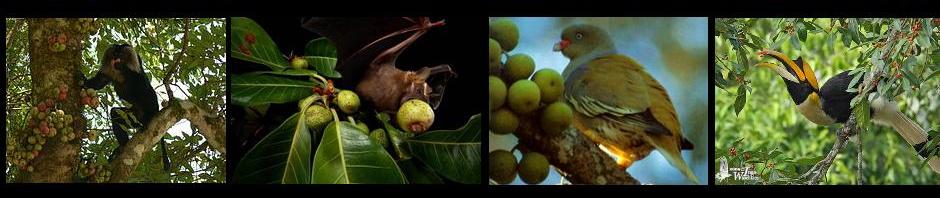
I’m a vulgar fig-eater. Few things give me more pleasure than when I bite into a ripe one and eat it up. With the right fig, the flavours can be so intense, so rich that it seems clear to me that no other fruit can compare. But the figs I eat are of just one of nearly a thousand fig species, and what eats the others is really interesting.

figeaters
Continue reading