A job for conservation’s keystone cops

Take the keystone away from an arch and down will tumble the whole structure. Take a keystone species away and — so the concept goes — other species will go extinct too. In his excellent recent feature for Nature, Ed Yong explains how biologist Bob Paine came up with the concept while he studied starfish in the 1960s.

Paine’s keystone species concept “would go on to be applied to species from sea otters to wolves, grey whales and spotted bass” and — a group Ed missed from the list — wild fig trees, whose huge crops are available year-round and keep more animals alive than any other species.

For this reason, Ed’s article brought a blush to my cheeks. As I read it I recalled the time a journalist falsely quoted me, to suggest that I “came up with the idea of figs being a keystone”. Sixteen years later those words still make me wince, for they made it seem I had stolen another scientist’s idea. In fact it was Professor John Terborgh, then of Princeton University, who had been the first biologist to apply Paine’s keystone concept to fig trees.

The journalist had interviewed me in 1997 for The Reporter, a newsletter for staff and postgraduate students at the University of Leeds, because I had won a prize in the Daily Telegraph Young Science Writers competition with an article about fig trees. While I am certain Professors Terborgh and Paine never saw the piece, I remember well the horror I felt when I read the words the journalist had put into my mouth. The experience would guide me well in my own journalism years later.

Now, thanks to the memories Ed’s article has triggered, I’d like to set the record straight and also publicise a vast dataset that nearly got lost and which explains why figs are so special. I can trace its origins back through the work of both John Terborgh and Bob Paine.

Here too is the story I wrote that got The Reporter‘s journalist all worked up. Please forgive its naivety and clunky construction — it was my first ever attempt to write about science for a non-technical audience and it is clear to me today that I was still writing then as a scientist.

Some months later, on 18 February 1998, The Daily Telegraph published it with the title ‘Answering the distress call’. I prefer the title I submitted at the time — the one I have used for this blog post.

Figs: A job for conservation’s keystone cops

It is a myth that in tropical forests the bounty of nature’s larder is available year round to support fruit-eating animals. In reality, they may experience alternating episodes of feast and famine, with fig-eating potentially meaning the difference between life and death.

Many tropical fruit-bearing plants share seasonal fruiting patterns, with one or two peaks of ripening at the same time each year. Fig trees, though, can fruit at any time and, so, many sustain fruit-eaters through lean times. As well as providing for the vertebrates, figs may ensure the survival of more rarely fruiting species by maintaining animals which disperse their seeds. By attracting seed dispersing animals, figs may also be instrumental in the recolonisation of deforested areas, or volcanic islands.

Ecologists have described figs as keystone resources in tropical forests. Just as the removal of a keystone of an arch is quickly followed by its collapse, the loss of ecologically important keystone species may trigger a cascade of local extinction.

With more than 800 diverse species, fig plants exhibit great variety — including trees, climbers, shrubs, bushes, epiphytes and tree-stranglers. More so than any other wild tropical fruit, figs provide a large dietary contribution for a veritable Noah’s Ark of animal species. With varying colour, design and position, figs attract different types of vertebrates. The weird and wonderful mix of fig-eaters includes: fish, lizards, giant tortoises, birds, fruit bats, monkeys, rodents, bearded pigs, spectacled bears and the oddly-named olingos, kinkajous and binturongs.

Year-round fruiting is good news for the fruit-eaters, especially as fig trees produce superabundant crops (up to one million figs) and have only short intervals between fruiting episodes. The best documented of fruit shortages is the 1970-71 famine on Barro Colorado Island (BCI), Panama, where in the eight months from July 1970, fewer than 50 per cent of potentially productive plant species bore fruit. Intense hunger stress among fruit-eaters resulted in so many deaths that vultures could not cope with the supply of corpses. Starvation declined suddenly when figs came to the rescue — with peak fruiting in January and February 1971.

More recent research has identified a possible keystone role of figs in Peninsular Malaysia, Borneo and Peru’s Amazon basin where Princeton University’s John Terborgh suggests that loss of figs could lead to ecosystem’s collapse. However, at other sites in Gabon and India figs are apparently less important — being present at low densities and feeding only a small proportion of fruit-eaters. The importance of fig species evidently varies (to misquote George Orwell, “some figs are more equal than others”) either due to their distribution, density and crop size, or as a consequence of animals’ abilities to locate and utilise the fig resource.

Ecologists need to act as “keystone cops” to identify which fig species are disproportionately important in tropical forests with rollercoaster fruit economies. This requires exhaustive fieldwork, encompassing studies of fruiting patterns of figs and other species and behavioural studies of fruit-eating animals.

In Shakespeare’s Antony and Cleopatra, one of the queen’s attendants declares, “I loved long life better than figs.” Tropical fruit-eaters may be able to enjoy both, living longer through their love of figs. If some fig species are show to have keystone importance, their protection may be vital to tropical animal communities. This conservation goal is not too far out of reach as to be unrealistic.

In re-typing these words, I’m pleased to note how much I would write it differently today. I’m amazed too that I managed to wrote about figs being important to wildlife without mentioning the fig-wasps that are the reason for that — see The humbling history of the tiny wasps that upset a Jurassic Park narrative.

The article I wrote back in 1997 won me subscriptions to Nature and New Scientist. Later on it helped me secure funding for a PhD and get my first two jobs outside of academia. It was a real keystone in my career.

Like so many of the researchers Ed Yong highlighed in his Nature piece, I owe some words of thanks to Bob Paine, the man whose starfish throwing days set so many biological balls rolling. As Ed notes in his blog Paine is a keystone too.

Confession: I ate shark fin soup

Photo by Albert Kok http://en.wikipedia.org/wiki/File:Tiger_shark.jpg

Late in 1998 a man hauled a shark out of the sea. With a sharp knife he hacked off its fins and put them somewhere safe, then he tossed the mutilated fish back into the ocean. Its blood clouded the salty sea. Unable to swim, the shark sank to the sea bed where it died a slow death… all so I could eat a bowl of soup.

No… No… No. That won’t do. I never saw the shark die. I don’t know its final moments. I don’t know who caught it, and where or when or how. But, yes, I did eat the soup, and whenever I think of that meal I paint the above picture in my mind. It is possible that it is a perfect portrayal but I just don’t know for sure. Continue reading

The mystery bird that called for a dictionary of vanishing voices

birddiction2

In the summer of 1897, the call of a mysterious bird sparked a brief but thorough quest whose hand-sized outcome is a curious testament to the speed of change in our world.

A retired engineer called Charles Louis Hett heard the bird near his home in Brigg, a small town in Lincolnshire in the north of England. Certain he had seen the bird’s call described in print a few days earlier, Hett scoured his books — but he couldn’t find the paragraph so he couldn’t identify the bird.

What followed was a six-month burst of research and writing. Hett scavenged scraps of information from books. He corresponded with strangers around the country. He walked in the wilds with his ear to the sky. His aim was to build consensus around a definitive descriptive list of the calls of nearly 400 bird species. By January 1898, his small ‘bird dictionary’ was on sale.

A few years ago, my mum found a copy of it in a second-hand bookshop and gave it to me. It still amazes me as I hold it in my hands. Among the calls Hett listed are the Red-throated Diver’s “ak-ak-kakara-kakera“, the Whimbrel’s “tetty-tetty-tet” and the “tst-tst-tsook-tsook” of the Red-backed Shrike. Just like the French-English/English-French dictionaries I remember from secondary school, Hett’s book first lists the hundreds of calls and the birds that make them; it then lists the bird species and the calls that each makes.

But it is what comes next that interests me most — a list of 1,300 local and old-fashioned names for British birds*. There you can find the Stanepecker (for Turnstone) and the Scawrie (for Herring Gull), the Rusty Crackle (for Blackbird) and the Teapot (for Goldcrest) — each one is a name that is rarely, if ever, uttered today.

It’s hard to imagine how Hett managed to compile so much information in just six months, working from a tiny town about 100 years before the Internet entered public life. What’s more striking is that an effort to replicate Hett’s mission today would likely fail. Many of the names will have slipped out of use. Gone extinct.

Many of the birds have gone too. The new State of British Birds report [PDF] shows that populations of many British birds are in steep decline. In the past three decades alone, several species have declined by more than 80 percent. Extinction beckons. “Since 1966, we’ve lost 44 million individual birds from our countryside at an average rate of 19 birds every 10 minutes,” says a joint statement from the organisations behind the report.

We don’t know what populations were like when Hett heard his mystery bird but we do know that modern threats — pesticides, habitat loss, climatic change — had yet to make themselves known.  The only danger that Hett himself noted was from people who killed birds so they could identify the corpse — something that helped motivate him to publish his dictionary. “The destruction of an uncommon bird for the purpose of identification, is a barbarism,” wrote Hett, who hoped his book might prove an “aid to identification without slaughter.”

It is easy to dismiss Hett’s world as a long-forgotten yesterday. But, given that the oldest person alive today was born some months before Hett heard his mystery bird, the dictionary shows just how much the world can change in a lifetime. And it seems likely that some of the species Hett listed will have fallen forever silent —  in Britain at least — by the time I pass my copy of his book on to my own child.

*[By 1902 Hett had published an updated list [PDF] that more than doubled the number of synonyms to nearly 3,000 names — an average of more than seven for each real species.]

Why blog? Ten things I learned about blogging this year

This post is inspired by one that Bora Zivkovic, the blog editor at Scientific American, published about his year of blogging. With fewer than a hundred posts here at Under the Banyan, I’m still a novice — but I want to share what I’ve learned while blogging this year, along with links to some of my favourite pieces.

1. In science, stories lie like fossils that wait to be unearthed
I wish I had more time to find and read new scientific papers. They offer a treasure trove of stories that would otherwise go unreported. I really enjoyed the time I spent on this one, a humbling history of tiny wasps. Here’s the intro…

It’s the land that time forgot, a remote island whose strange life forms have survived in splendid isolation since the time of the dinosaurs. Or is it? Because while biologists have long thought this, geologists disagree. Now, genetics detectives may have closed the case with a study of tiny wasps. Their findings are a reminder that we are just part of a much bigger picture and of a story that never ends.

2. Blogs give research wings
One of my most popular posts this year was about a rain forest I had lived and worked in over ten years ago. The near empty forest that proves conservation is failing describes new research by my former colleague Rhett Harrison. He showed that many large bird and mammal species had gone locally extinct in a Malaysian national park. When I first noticed his paper and asked him about it he told me there had been no media coverage. This encouraged me to write the story. In the next few weeks more than 1200 people read it, thanks in part to Andy Revkin, who mentioned it on his Dot Earth blog on the New York Times website. What I learned with this post is that there is a value in telling a story no one else has told (more than 70 readers downloaded Rhett’s paper via my site) and that a link from a bigger blogger drives a lot of traffic (thanks Andy!).

3. Nothing works like what you know
To write about what interests you can be fun, but to write about what you alone know is to be carried — and to carry readers — further and faster with an even deeper flow of words. Childhood memories, personal journeys and family anecdotes are the salt of many a story, such as these two from this year: Lost in a forest in search of a golden vale and black magic and What trees tell us when we stand close and listen.

4. Images can spark — or replace — stories
Often when I ask myself what I will blog about next, an image provides the answer. Two of my favourite posts this year arose after a powerful image took hold in my mind. One was a photograph of four long-dead elephants. The other was a multi-million dollar sculpture, the world’s biggest of a spider. Images go a step further and dominate the words in my Postcards series. These are quick image-led posts that can provide some pleasure to the eye when my words won’t flow or a real story seems shy. See the postcards from Hanoi (A city of a thousand fig trees), London (Autumn leaves as autumn arrives) and Jersey (Why a child played on ancient graves).

5. Speed matters — as does voice
If you were anywhere near the Internet in March you would have heard of the ill-fated Kony2012 campaign. When the story broke, I got in touch with a journalist friend in Uganda straight away so that I could share the views of someone there as she reacted to a strange narrative that some idealistic young Americans wanted to impose. That piece — A cautionary tale: Kony 2012 – The backlash — broke all records on my blog. More than 15,500 visitors read it in one month.

6. While long is legal, brief is still best
With pages that need never end, and no editor to bend your ear about word counts, a personal blog is a recipe for bad, lazy, overwriting. Yes, long reads are a good thing — if done well. But in general, less is more. I got a taste for this when The Guardian asked readers for a movie review in just 200 characters. My short effort came up trumps — and inspired a blog post (see Southern Beasts: a story to spark climate conversations).

7. Repeat visits need not be a bad thing
Twice this year I revisited stories from the past, with new posts that built on the old. One was about the murder of journalists who report on environmental issues. The other was about the way The Guardian newspaper excluded journalists from developing nations from its ‘international development journalism’ contest for the second successive year. I learned here that if a story is worth telling first time around, it is worth updating.

8. Oldies can be goodies
Some of my most popular posts this year are pieces I wrote last year or even the year before. I’m not sure what makes them endure. In some cases I think the titles are attractive to web surfers but for others I have no clue. Here are the top oldies that proved a hit again this year…

9. Blogs open doors to new knowledge
I wrote a tale of typhoons, trees and tiny creatures… during a work trip to Vietnam. The story is okay on its own, but look at how much better it is with Pam McElwee’s comment. After she wrote, someone called Shrinky Dinky asked a good question. This forced me to go back to the expert I interviewed for more information, which I published here. So the blog post got better thanks to the readers and my reactions to them. I’ve never met Pam and Shrinky in person, but I now follow them both on Twitter and we have interacted since.

10. Respect readers: reach out and react to them
One great thing about writing a blog is that you get to know how many people read each post. What’s even better is when someone comments and you know that your words have had an effect. So I’m hugely grateful to readers in 165 countries who visited my blog in 2012, and especially those who have enriched my stories with their comments. Something I have learned is that a blogger needs to put in the effort to attract regular readers. For me that means sending links to individual posts to contacts in relevant places or fields of work, promoting the content on Twitter and responding to readers who comment.

What else?
There are a few other things I have learned about blogging this year but the main thing is just how much I like it. Blogging is a meditative, relaxing and rewarding process — the perfect exercise for an overworked brain.

A big thank-you to readers from 165 countries

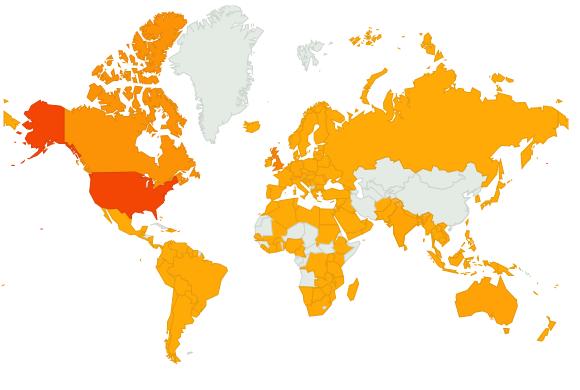
I came close this year to killing my blog and I’m glad I changed my mind. It is thanks to readers like you, who have visited Under the Banyan from 165 countries in 2012 (see map).

MapBanyan

Writers can’t stop writing. That’s a simple fact. But when we know that someone — even just a single distant stranger — will read our words and perhaps devote a thought to them, we write harder and better, with more energy and passion.

So, I want to say a big thank-you to everyone who has visited Under the Banyan and has read or commented on my posts here.

I would also like to know some more about you, so please leave a comment here and tell me who you are, where you live, what you do and what you would like to see at Under the Banyan in the future.

I wish you a happy and peaceful 2013

Mike

Missing women might explain failure of UN climate change talks

photo2red2

This giant spider has reminded me once again of who’s too often missing from the climate conversations we sorely need.

The spider straddles the main concourse of the Qatar National Convention Centre in Doha, host of COP18 — the 2012 round of UN negotiations aimed at tackling climate change.

This is a massive irony. While the spider — called ‘Maman’ — is a monument to motherhood, the negotiators who passed beneath her during the two-week conference were largely men.

In fact, there has never been a conference of parties (COP) to the UN climate change convention at which even one-third of the negotiators were women. In recent years women were the heads of fewer than 15 per cent of the national delegations. This chart from GenderCC shows the disparity.

share_women_delegations_2011b

This shameful pattern is set to change. One of the few rays of light to shine out of the Doha conference was a decision [PDF] by the nearly 200 governments present to promote gender equality in the negotiations.

What’s shocking is that it has taken 18 years for governments to get to this point. What’s saddening is that the language of the binding decision remains weak. It only “invites” countries to strive for gender balance in their delegations. What’s a source of hope is that gender and climate change will now be on the agenda of all future negotiations.

Until more women participate in the UN climate change conferences, we can expect a male-skewed view of the problem and ways to solve it. We can expect outcomes that fail to reflect fully the needs, wisdom and vision of half of the world’s population. And we can expect more of the bullying and indifference to suffering that have tainted the talks over the years.

The failure of the talks so far — the slow progress, the weak agreements, the lack of leadership — has been the failure of men. I’ve attended the negotiations for each of the past six years and each time I’ve come away less sure that the big men of the world who claim to be leaders have any real desire to lead.

This time it’s personal. This time I am a father-to-be with a child in my mind. So when I arrived at the Doha conference and saw the giant spider, it mesmerised me. I knew that Louise Bourgeois had made the sculpture as a tribute to her mother, who had died when Bourgeois was 21. I spent 30 minutes there deep in thought about my wonderful pregnant partner, thousands of miles away, about the family we will form together and the climatic changes our child will experience.

For the next five days, I took a photo of the spider every time I passed it and counted the number of men and women who stood beneath the sculpture. It’s not scientific, I know, but for every woman, there were 2.6 men. I wonder how many of them saw the plaque on the wall that named and explained the sculpture with a quotation from the artist:

“The spider is an ode to my mother. She was my best friend… Like spiders, my mother was very clever… spiders are helpful and protective, just like my mother.”

Clever. Helpful. Protective. That’s just what the UN climate change negotiations need to be but what, mostly in the hands of men, they are not. Perhaps they will be when more women —  more mothers — take part.

Maman

Climate change communication: ‘A’ is for audience

Suriya Begum is a poor young mother from Bangladesh. When her photograph appeared in a media story about climate change earlier this year, it was only so the article could show a victim — not so it could share her views.

The article presents plenty of facts but doesn’t refer to Suriya’s life or anyone else’s. Tan Copsey of BBC Media Action says this example highlights the potential – wasted in this case – for media outlets to explain what people know, think and feel about climate change.

Speaking at the Climate Communications Day during the COP18 conference in Doha he said: “Don’t you want to know, as a room full of communicators, how she is affected and how she gets her information?”

To answer questions like these on a grand scale, BBC Media Action’s Climate Asia project has interviewed 33,000 people in seven Asian nations. It has asked people about their values, priorities and perceptions, about where they get information, what they experience of climate change and how they react.

The full results aren’t out yet but some things are already clear, said Tan and his co-presenter Lottie Oram.

  • People across Asia are noticing climatic changes and what they see worries them.
  • Some people are adapting to new conditions. Others resist any change to their lifestyles.
  • And so far, people don’t get much information about climate change from the media, though they think it has a role to play in reaching them.

Internews’ Earth Journalism Network and IIED — where I work — organised the day to explore ways communicators can use new approaches to reach new audiences with information about climate chanage. In the discussion that followed Tan and Lottie’s presentation, it was clear that the gathered experts felt the mainstream media was failing to fulfil its potential.

First — whether in Asia or America or anywhere in between — editors still have some kind of blind-spot when it comes to climate change. There is a climate-change angle to most of what appears in a newspaper but the subject still rarely gets a mention, not even in the final paragraphs.

Even with supportive editors, journalists face some big challenges in reporting on climate change. Imelda Abaño, president of the Philippines Network of Environment Journalists mentioned the risk of danger. Indeed, across the world reporters are threatened, hurt or even killed for reporting on environmental themes.

Compared to the size of the story, media coverage of climate change remains disproportionately small. But the Climate Asia research hints that, for people like Suriya, journalism may be less effective than entertainment. It identified newer approaches to climate communication that appear to be gaining ground.

One idea from Indonesia is a ‘lifestyle-swap’ reality TV show about climate-related migration. In Vietnam, a TV game show pits farmer against farmer to show off and share knowledge of how to adapt agriculture to the changing climate.

These are the kinds of shows that appeal highly to specific audiences. And this is where Climate Asia is set to be a gold mine of information that should help people to better communicate about climate change, thanks to its detailed interviews with over 30,000 people.

At Climate Communications Day in Doha, Tan explained how the interviews in Bangladesh gave deep insights into what climate change means to women like Suriya who live in the slums of Dhaka.

Her priorities: “Her most important priorities are her child and family, shelter, electricity, food, having clean water to drink and staying healthy. She is particularly concerned about the health of her child.”

Her perceptions: “She perceives changes in climate around her. Where previously there were six seasons now she only experiences two – summer and winter. She is very worried about this and changes to her environment.”

Her actions: “She has raised her bed above the ground in case of heavy rains or floods.”

Her needs: “She’d like to do more to respond to the impacts she’s feeling but she doesn’t feel she has enough resources or information about what to do. Other people around her aren’t doing more – which is also important as she values being respected and fitting in people around her. She wants more information on how to conserve and use the resources she has.”

Her trusted sources: “She trusts the information she receives from family, friends and people from her neighbourhood. But she also trusts academics, teachers and religious leaders.”

Her use of media: “She prefers TV to other media – she trusts it because she can see it – she watches TV in a communal area, especially in the early afternoon when she’s finished with her household tasks and men from the slum are at work. She likes Bengali movies and TV drama serials. She talks about what she watches with other women in the slum. She once saw something about climate change on TV but didn’t understand it.”

Journalists and other communicators take note — especially to that final point. It is depressingly familiar. How often do climate-change communicators take the time to understand what audiences know, think and feel about climate change? Not often enough I fear.

*This post first appeared on IIED’s blog

Postcard from Jersey: Why a child played on ancient graves

20121112-190410.jpg

As a small boy I played among these stones, unaware they were remains of graves unknown people built around 5,000 years ago. I had a better way to explain their presence — one Walt Disney might have liked.

The stones are called Ville-ès-Nouaux and they stand to silent attention in the centre of St Andrew’s Park on the island of Jersey where I grew up.

Jersey has several such structures and we call them ‘dolmens’. Like the skeletons of bigger beasts whose flesh time has torn from the bone, they were once covered with earthen mounds that centuries of wind and water — and some helping human hands — have carved away from the stone.

The structure at the rear of the picture was a gallery tomb, once covered with a long low mound, that people built in 3250-2850 BC. The grave in the foreground is a few hundred years younger, installed there between 2800 and 2000 BC. Its outer ring of stones once served to hold in place a high mound of earth.

Over millennia these tombs vanished from view as sand swept in from the shore to the south and dunes rose up over the remains.

It wasn’t until 1869 that local men unearthed the long gallery tomb during a search for rocks to build with, and it seems they took two of the horizontal cap stones and left the seven that lie there today.

Archaeologists have since found pottery and ashes but not much more to describe who deserved such special burials. But children who played there as I did in the 1980s didn’t need expert answers — we had a story of our own to explain the presence of the stones.

To us they were the graves of Snow White and the Seven Dwarves. So we played there in the park without fear in our growing bones.

I always like to visit this site when I return — as I did a few days ago — to the island of my birth. They are silent but they speak loud of the circle of life and death and endless renewal.

Will Obama let the climate do all the talking?

Climate chatter may seem loud to those who seek it, but it occupies a vanishingly small part of public debate in the United States. This pair of images that Andy Revkin has shared shows this only too well.

Meanwhile, too much of what has been said and written about climate change has come from the shouters not the listeners — from oversimplifying environmental groups or conservative conspiracy theorists or powerful vested interests or proud anti-science billionaires. As an example of the latter, here’s what Donald Trump told his nearly two million followers on Twitter on 6 November 2012.

This kind of idiocy cannot sustain itself. It won’t be long before everyone knows someone who suffered the effects of an extreme climatic event. Climate change — that once intangible and distant concept — is doing the leg-work for the communicators who have struggled to make this issue feel real.

Hurricane Sandy hammered home that point. Whether or not humanity had a hand in the storm’s impact is fairly academic (see David Shukman’s report on what science can and cannot say at this stage). What really matters is that Sandy showed that even a rich city in the world’s most powerful nation is vulnerable.

Some commentators hope Sandy has blown open a door to a mature conversation in the United States about climate change. It’s a conversation the world needs Americans to have — both with each other and with the rest of us.

But a quick read of George Marshall’s thoughts on psychology and climate change suggests it might take more than disasters to get the conversation rolling.

This is where President Obama needs to step up. In his 2012 election victory speech Obama said: “We want our children to live in a world… that isn’t threatened by the destructive power of a warming planet.” Does he mean it this time, or was this just another tease?

In the past Obama has flirted with a leadership role on climate change. But he has blown hot and cold — courting climate action in 2008 then shying away in 2009. He barely mentioned climate change in recent months — not even in the pre-election debates — and this in the year of a record-breaking US drought and super-storm Sandy.

Obama’s strategy has been to follow public opinion rather than lead it. This may have seemed astute, for few Americans are ready to confront a climate narrative that so forcefully challenges their worldviews, which hinge as they do on faith, freedom and the pursuit of the mighty dollar. But as Calestous Juma has pointed out: “The fact that you aren’t interested in climate change doesn’t mean climate change isn’t interested in you.”

It will take leadership, tolerance and safe spaces to encourage the American public to join the climate conversation. Obama must reject his old ‘now you see it… now you don’t‘ approach to climate change, which allowed his opponents to shackle the discourse to a political roller-coaster whose only destination was deadlock.

The world needs climate conversations that involve Americans as citizens, not just as Democrats or Republicans. The alternative is to let the climate itself continue to do most of the talking — and none of the listening.