Southern Beasts: a story to spark climate conversations

A little girl takes Nature’s pulse and finds it’s lost its rhythm. As her universe unravels and the climate flexes its muscles, she learns all is connected and that community is the key to resilience.

That’s my 200-character review* of Benh Zeitlin’s new film Beasts of the Southern Wild. It’s a timely movie — a story of survival in a poor part of the United States where the vulnerable suffer and go hungry while the wealthy consume and pollute.

The narrative chimes louder since Hurricane Sandy joined its big sister Katrina as the second mega-storm to strike the United States in just eight years. And while the film is about the United States, the community at its heart has experiences that echo those of poor people across the planet.

Here’s the trailer…


[*Update: 3 December 2012: I wrote the 200-character review for a competition run by The Guardian. My good news is that I heard today that I won. The film touched me deeply so the words came easy. I hope you find it as interesting and moving as I did.]

An obituary for long-dead elephants

My girlfriend and I found these four elephants framed in a photograph in a bar last week in London. It was clear to us that the animals had arrived in our city by sea, but when and from where? I decided to seek out their story. Here’s what I found…

*

The photo was much more recent than I had imagined — it showed London’s South West India Docks in 1968. I had assumed the elephants were new arrivals from Asia but they had come to England 20 years earlier and were just returning from their latest overseas trip. These animals had names. From left to right that’s Sally, Lelia, Mary and — in the sling — Camella.

For now though, focus on the man with the stick. His name was John Chipperfield and his family had been putting on shows with performing animals since the 17th century. Back in 1684 John’s ancestor James William Chipperfield held his first animal shows during the Frost Fair that took place on London’s River Thames, whose surface often froze solid in the midwinters all those years ago.

Two centuries later, his descendant James Frances Chipperfield (1846-1917) would often boast: “I can train anything from a rabbit to an elephant.” Future generations of Chipperfields would forgo the former to lead with the latter.

In 1947, Dick Chipperfield travelled to Sri Lanka and began to buy the big beasts. First up was six-year old Camella, the one hanging from the harness in the photograph. Next was Mary. Chipperfield bought her from a rubber plantation where she was herself training a younger elephant to fetch and carry. Later he found Sally, whose forehead bump meant good luck in Sri Lanka.

That year the Chipperfields shipped 21 Sri Lankan elephants to England, a journey of several weeks on high seas that I imagine would have disconcerted the creatures. One of them died at sea just two days into the journey. By December the rest were performing in a circus at Harringay Arena in north London, where today a Carphone Warehouse stands. Hollywood legend Mae West was among the many people who saw the elephants there that winter.

Nine years later, in 1956, Sally, Lelia, Mary and Camella were part of a large group of elephants that the Chipperfields sent to Ireland to entertain new audiences. The circus sold several of the touring party to new owners there but brought these four females back to England. Mary was then sent to Rome in 1963 to star in the movie Cleopatra, with Elizabeth Taylor riding on her back (seen below).

A couple of years later Mary made an even longer journey, again with Sally, Lelia and Camella who by now had been together for nearly 20 years. All four were in a group the Chipperfields sent to tour Southern Africa between 1965 and 1967. The photograph I saw last week showed them upon their return to London. It was the beginning of the end for this well-travelled quartet. Camella died the following year. The others became known as The Big Three and performed together for another decade. Mary survived until 1978. Sally and Lelia were both at the circus when a fire broke out in 1979 and died soon after as a result.

Around this time reports of cruelty to elephants began to emerge from circuses around the world. This report [PDF] from the Humane Society of the United States lists several cases in which keepers beat elephants with hooks, or otherwise failed to care for their health and welfare. It includes reports on the famed Chipperfield dynasty, for which the era ended in ignominy.

Between 1997 and 1998 activists secretly filmed staff at the headquarters of Mary Chipperfield Promotions beating elephants. Their footage led to a public backlash against animal circuses. Elephant keeper Steve Gills was jailed for cruelty in 1998. The following year, a court found Mary Chipperfield and her husband Richard Cawley guilty of animal cruelty too — she for abusing a chimpanzee, he for whipping a sick elephant. Then in 2000 The Mirror newspaper claimed that Mary’s cousin Dickie Chipperfield had treated elephants cruelly — to which he reportedly replied: “There are elephants treated worse in India, you know.”

Cruelty continues. PETA says 29 elephants have died in the care of a single circus in the United States in the past 20 years. Meanwhile, the keepers of England’s last circus elephant face cruelty charges that stem from another case of undercover filming. If these things can happen today, then what did performing elephants endure decades ago when animal welfare was a little-known concept and whistleblowers were rare.

The elephants whose photograph I saw last week had already lived through 20 years of training and touring when that photo was taken. They had spent weeks at sea and had returned to face another chapter of a life in chains. As my girlfriend and I peered closer at that picture we noted the way the three standing elephants all faced towards the fourth, as it hung suspended in mid air. But what really pulled us into the picture was the way one elephant had reached out its trunk to touch the one being lifted away.

Elephants are intelligent, social creatures and they touch each other like that with purpose. Perhaps the animals in the photograph were aware that their imminent upheaval might be more than merely physical.


Why following the herd can be good for journalists

Banditry, robberies, infiltration of small arms, poaching in the region’s game reserves and national parks and frequent outbreak of livestock diseases are now being attributed to the uncontrolled movement of pastoralists and their animals.

This sentence, from a 2006 article in Kenya’s The Nation newspaper, encapsulates the way the country’s nomadic herders have been — and continue to be — portrayed in the media there. It echoes the dominant policy narrative, which says pastoralism is a backward system that takes place a harsh, unproductive environment and that when herders move to seek water and pasture they create problems for other people.

But this, say researchers, is a dangerous narrative, one that is blind to the true nature of the lands the pastoralists move across and to the knowledge they draw upon to take advantage of resources that are distributed there in an unpredictable way.

Today, the meat and milk pastoralists provide help to feed a nation. As the climate grows more variable, these people could become even more important cornerstones of Kenya’s economy and food security.

But, in the pages of newspapers there, the herders are not heroes — they are harbingers of conflict and other problems. In short, Kenya’s pastoralists have an image problem. This much became clear when I analysed 100 stories about pastoralists that Kenyan newspapers published between 2000 and 2012.

My study, which will also examine articles from India and China, is part of a larger Ford Foundation funded project. It aims to promote more progressive narratives, and policies that support mobile pastoralism as a rational, productive livelihood in lands where water and vegetation vary in space and time. Some patterns soon emerged:

  • In Kenya, pastoralists tend to feature only in ‘bad-news’ stories – 93% of the media reports referred to conflict or drought.
  • While 51% of stories that mention conflict presented pastoralists as a cause of problems, only 5.7% suggested that pastoralists might be the victims of the actions (or inactions) of others (e.g. farmers or government policies).
  • An astonishing 22% of all articles referred to pastoralists as “invaders” or as having “invaded” land.
  • Pastoralists have little voice. They were quoted in only 41% of the stories journalists wrote about them.

I supplemented my content analysis with an online survey that 42 Kenyan journalists completed. “The media only gives special attention to pastoralists when there is a crisis, like a major drought or famine where large numbers of people and animals have died,” said one. Another said: “Pastoralism is generally ignored. It only makes headlines when there is cattle-rustling and scores of people are killed.”

I asked the journalists to state five words they associated with pastoralists. The figure below shows the words they chose, with word-size reflecting how often a journalist used it.
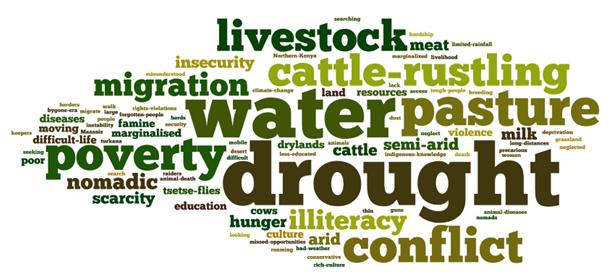
It’s a problematic portrait. Yet when asked more specific questions, the journalists revealed knowledge and opinions that seem to contradict the dominant media narrative.

Most (91 per cent) of the journalists acknowledge, for instance, the importance of pastoralism to Kenya’s economy, with more than half of them stating that this is major. This surprised me, given that this was invisible in the stories I analysed. Only 4 per cent of them mentioned it, and not one published a figure such as a shilling, dollar or GDP value.

Other things the journalists said suggest that there is an opportunity for a new narrative to emerge in the Kenyan media, one that does not ignore the social, economic and environmental benefits pastoralists provide.

“The media has neglected pastoralism, since its takes place in far flung areas of northern Kenya which the government has neglected for years,” said one journalist. Another noted that: “Pastoralism has a chance to become a key growth sector for Kenya’s economy if supported by media and policy makers alike.”

A 2011 article, by Peter Mutai for China’s Xinhua news agency, shows another narrative is possible. It manages to overturn much of the prevailing one in just its opening sentence:

As hunger spreads among more than 12 million people in the Horn of Africa, a new study finds that investments aimed at increasing the mobility of livestock herders, a way of life often viewed as “backward” despite being the most economical and productive use of Kenya’s drylands, could be the key to averting future food crises in arid lands.

Mobility is the key that pastoralists use to unlock the scattered riches of Kenya’s drylands. The landscape may appear barren, extreme and risky to city-based journalists but the pastoralists have the knowledge and skills to take advantage of the land’s variability and diversity.

The old proverb that says “a fool looks for dung where a cow has never grazed” can perhaps be turned on its head to serve as a reminder of the riches – of stories and more – that a reporter can find if they follow the herd.

[This post was first published on the IIED blog]

Journalists are dying to tell stories of environmental plunder

It’s a sad reflection of reality that my first reaction to the news of Hang Serei Oudom’s murder was not one of shock or surprise.

The Cambodian journalist’s body was found last week in the boot of his own car. He had apparently been axed to death just days after reporting on links between the military and illegal logging there.

Oudom’s story was just the latest in a series that had shed light on the corruption and criminality that are tearing Cambodia’s forests apart for quick bucks to line powerful pockets. As the Bangkok Post reports, a military policeman has now been charged with his murder.

My lack of surprise as this grisly crime stemmed from the fact that Oudom is not alone, as I have noted in an earlier post here called ‘They kill environment journalists, don’t they?’.

It describes how journalists in Africa, Asia, Latin America and the former Soviet Union have been intimidated, threatened, beaten or even killed for coming too close to exposing the ways powerful figures enrich themselves while harming the environment that everyone else depends on.

The extent of these threats to environment journalists makes a mockery of the 20-year old commitment by almost all nations on Earth to ensure that the public has access to adequate information about the environment and can participate in decision-making about how it is managed.

Press freedom is key to delivering that information but, too often, powerful figures in governments, the military and environmentally destructive sectors see local journalists as nuisances who can be intimidated, bought off or shut up forever.

With the internet at our fingertips there is no longer any reason for such elites to succeed in silencing the stories of their plunder and what they are prepared to do to sustain it.

What’s needed now is for journalists across the world to join the dots. Because blood spilt in – for instance — a tropical forest can often be connected now with notes deposited in a Western bank or luxury hardwoods bought in a high-street store in China or Chicago.

When a journalist dies to tell a story, it becomes a story that deserves an audience like no other. When that story is about the flows of money and natural resources that make tough men rich and put poor people in peril, it doesn’t take much effort to see that it is a story that can touch us all.

[This post first appeared on Andy Revkin’s Dot Earth blog at the New York Times website]

Lost in a forest in search of a golden vale and black magic

The short walk with my parents in Irish woods last month now ranks in my mind alongside long expeditions through dense rainforests.

We were in Ireland’s County Limerick, in whose green hills and fields my Dad roamed as a child. He used to ramble up the flank of the Seefin mountain and look down into the Golden Vale, a wide stretch of fertile farmland that reaches across three Irish counties. In the late 1940s and early 1950s, this part of it was his playground. He forged the greatest gift he could ever give me in this crucible.

Continue reading

A tale of typhoons, trees and tiny creatures that stood between a community and climate resilience

Nguyen Viet Nghi’s enthusiasm was infectious as he showed off a scene of remarkable renewal in what was once a disaster zone. We were in Da Loc commune, a sleepy part of Vietnam’s Thanh Hoa province. It’s a place that on a single day witnessed both the fury and the protective power of nature. The community learned well from the experience, but only after they overcame the attention of some tiny animals that threatened to spoil the story. Continue reading

Postcard from Hanoi: A city of a thousand fig trees

I took a stroll in Hanoi today*. It’s a beautiful city. But parked motorbikes and perched purveyors of foods and goods possess its pavements. So to walk one must step into the streets and have faith in the swirling mass of motorists whose pulse keeps the city alive.

The constant sounds of their car and motorcycle horns beep and parp and wahdah-wahdah-wa-wa without pause. They tear the air and probably save lives, but they also kill a bit of a wanderer’s pleasure by drowning out other noises.

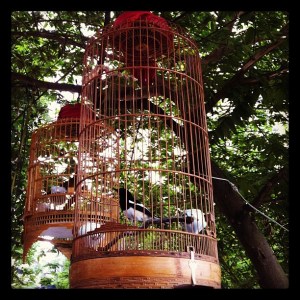
The only birdsong I heard today came from bulbuls and babblers and magpie-robins that hung from storefronts in little wooden cages. There’s an irony in their lonely captivity because Hanoi is also a city of trees, a city of fig trees that owe their existence to the some of the same species whose caged members no longer fly free.

Continue reading